

What Is Chainflip DCA? Better Rates on Large Swaps
Key Takeaways
- •Chainflip DCA mode splits large swaps into smaller chunks that execute sequentially through the JIT AMM, reducing price impact by giving market makers time to source competitive quotes for each chunk.
- •DCA is automatically recommended on LeoDex for large Chainflip trades — you see a purple 'DCA' badge showing the number of chunks. No manual configuration needed.
- •DCA and THORChain streaming swaps solve the same problem (slippage on large trades) with different architectures. LeoDex compares both in real-time and selects whichever produces the better output.
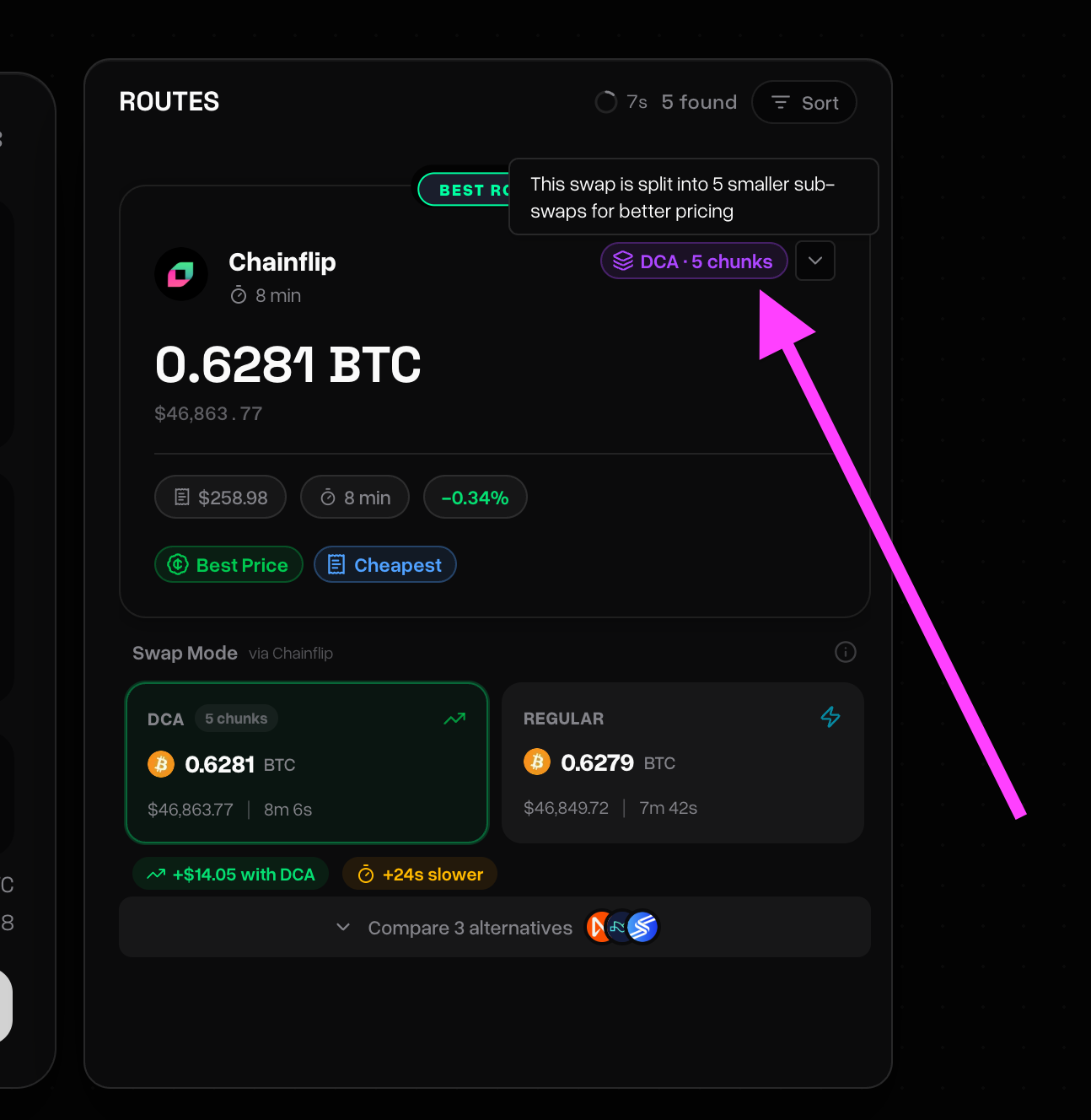
Chainflip DCA (Dollar Cost Averaging) mode splits large cross-chain swaps into smaller chunks that execute sequentially through the JIT AMM. Each chunk is filled by competing market makers, reducing price impact and getting you a better overall rate on large trades. On LeoDex, DCA is automatically recommended when Chainflip detects your swap is large enough to benefit — you will see a purple "DCA" badge on the route card.
Why Large Swaps Lose Money to Slippage
When you execute a large swap on any decentralized exchange, the trade itself moves the market price against you. This is called price impact — the larger your trade relative to the available liquidity, the worse your effective price becomes.
On a traditional AMM (like Uniswap), price impact follows a quadratic curve: doubling your trade size more than doubles the price impact. A $10,000 swap might experience 0.1% slippage, but a $100,000 swap on the same pool could see 1% or more — a $1,000 loss from price impact alone.
This problem is even more significant for cross-chain swaps, where liquidity pools are often smaller than their single-chain counterparts. Swapping $50,000 of BTC to ETH through a cross-chain protocol requires enough depth on both sides of the trade. Without a mechanism to reduce price impact, large cross-chain swaps are inherently expensive.
For background on how AMMs work and why liquidity depth matters, see AMM vs Order Book.
How Chainflip DCA Works
DCA mode solves the price impact problem by splitting your swap into multiple smaller chunks that execute one at a time through Chainflip's JIT AMM. Here is the step-by-step flow:
- You initiate a large swap — for example, 5 BTC to ETH. The Chainflip protocol determines the optimal number of chunks based on current liquidity conditions.
- Your deposit is divided equally — 5 BTC with 5 chunks means 1 BTC per chunk.
- Each chunk executes separately — chunk 1 enters the JIT AMM. Market makers compete to offer the best price for that 1 BTC. The winning bid executes.
- Interval between chunks — the protocol waits a short interval (typically 2 State Chain blocks, about 12 seconds) before executing the next chunk. This gives market makers time to rebalance their positions and hedge on external venues.
- Subsequent chunks repeat — each chunk gets fresh competitive pricing from the JIT AMM. Market makers bid independently on each chunk, so price impact does not compound across chunks.
- Output accumulates and is sent — the total output from all chunks is sent to your destination address once all chunks complete.
The key insight is that 5 separate 1 BTC trades create less price impact than a single 5 BTC trade. Market makers can fill smaller chunks more efficiently because they have time to hedge each one on external markets (centralized exchanges, OTC desks) before the next chunk arrives.
DCA vs Regular Swap: When to Use Each
Not every swap needs DCA. Here is how to decide:
Use DCA when:
- Your swap is $50,000 or larger — this is where DCA provides meaningful price improvement. A $100,000 swap might save 0.5-1% ($500-$1,000) compared to a single execution.
- You are swapping through a pair with moderate liquidity — BTC-ETH, BTC-USDC, and ETH-USDC are the most common DCA use cases on Chainflip.
- Rate matters more than speed — DCA adds execution time (typically 1-5 minutes depending on chunk count) but improves your output amount.
Use a regular swap when:
- Your swap is under $10,000 — at this size, the JIT AMM can fill the trade efficiently in a single execution with minimal price impact.
- Speed is critical — regular swaps execute in a single JIT AMM auction. Combined with Boost, a BTC swap can complete in under 1 minute.
- The DCA improvement is marginal — for swaps between $10,000 and $50,000, the rate improvement from DCA may be small enough that instant execution is preferable.
On LeoDex, you do not need to decide manually. Chainflip's quoting engine returns both a DCA quote and a regular quote. LeoDex shows the DCA route when it produces meaningfully better output, displayed with a purple "DCA" badge and the number of chunks.
How DCA Works on LeoDex
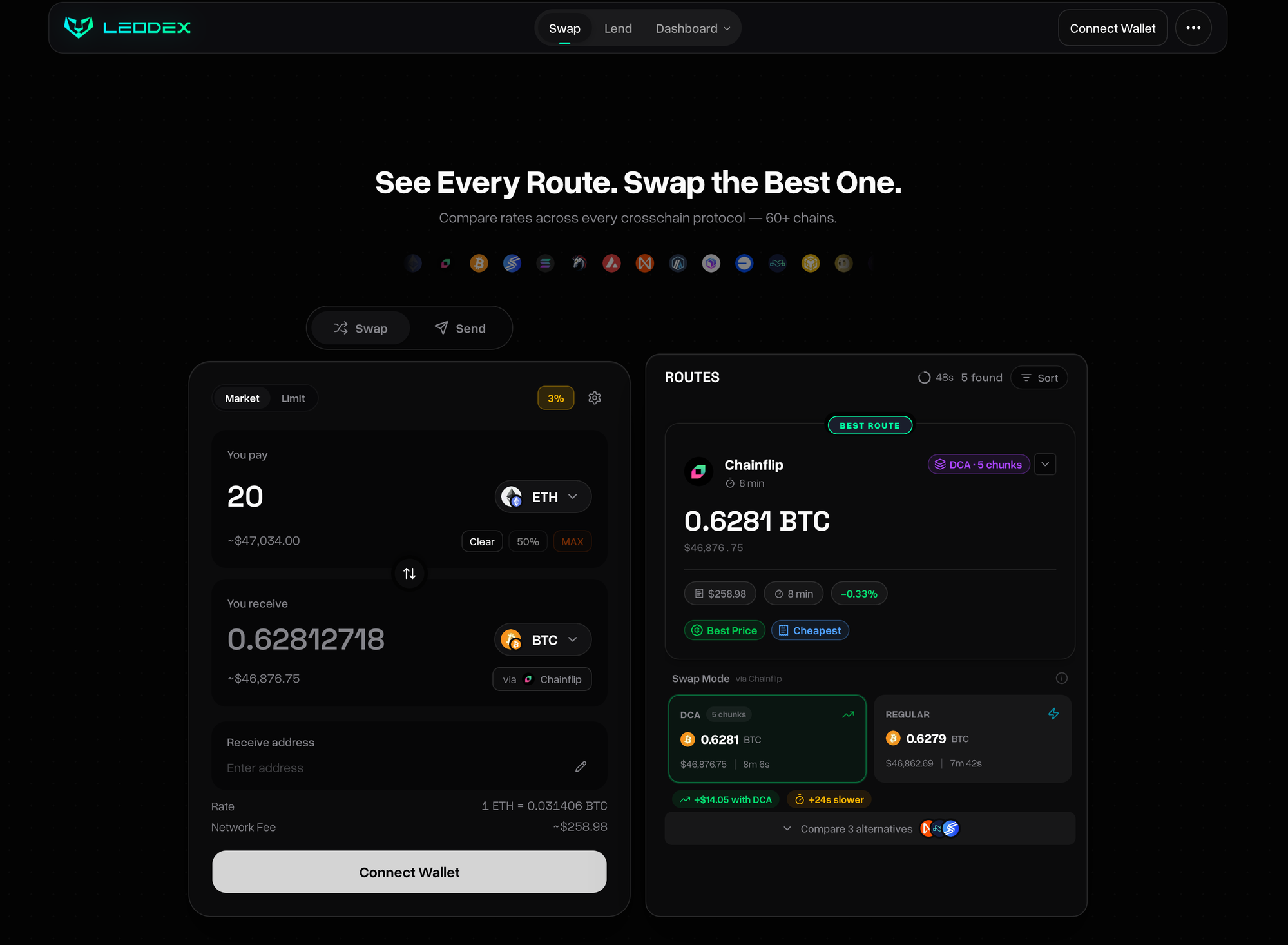
LeoDex makes DCA accessible without any manual configuration:
- Enter a large swap — for example, 5 BTC to ETH. LeoDex streams live quotes from all protocols, including both DCA and regular variants from Chainflip.
- See the DCA badge — if DCA provides a better rate, the Chainflip route card displays a purple "DCA" badge showing the chunk count (e.g., "DCA - 5 chunks").
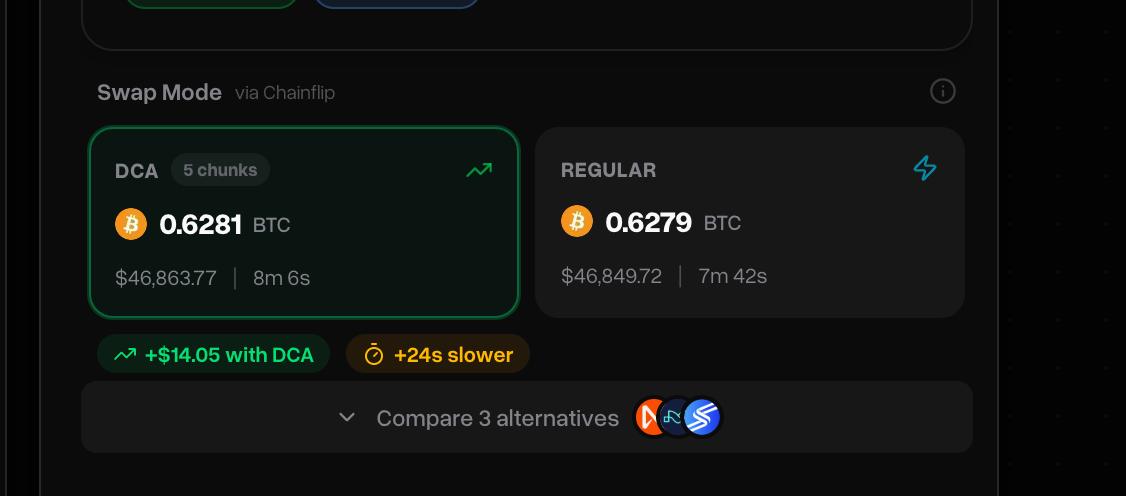
- Compare DCA vs Regular — LeoDex shows a "Swap Mode" toggle where you can compare the DCA rate (labeled "Value") against the regular rate (labeled "Speed"). The price difference is displayed as a dollar delta.
- Confirm and swap — select DCA if you prefer the better rate, or Regular if you prefer speed. Click swap and sign the transaction in your wallet.
The chunk count and interval are determined automatically by Chainflip based on your swap size and current liquidity. There are minimum chunk sizes per asset to ensure each chunk is large enough for efficient JIT execution.
DCA Pricing: How Fees Work
DCA does not add extra fees beyond what a regular Chainflip swap charges. Each chunk incurs the standard Chainflip fee structure:
- Protocol fee — 0.10% flat per chunk (0.01% for stablecoin-to-stablecoin pairs)
- LP spread — market makers embed a small spread (~0.05-0.15%) in their JIT auction bids
- Network fees — source chain gas (one-time, on deposit) and destination chain gas (one-time, on output)
The total cost is typically 0.2-0.3% for most swaps, which is the same as a regular Chainflip swap. The benefit of DCA is not lower fees — it is better execution prices per chunk, which compounds to a higher total output.
DCA can be combined with Boost for the deposit confirmation. The Boost fee (5-10 bps) is charged once on the initial deposit. Note that the Boost fee is not refunded if DCA chunks subsequently fail their minimum price checks.
Chainflip DCA vs THORChain Streaming Swaps
Both Chainflip DCA and THORChain streaming swaps solve the same problem — reducing price impact on large trades by splitting them into smaller parts. But they use fundamentally different mechanisms:
- Chainflip DCA uses a JIT AMM — market makers actively compete to fill each chunk at near-market pricing. LPs bid fresh prices based on real-time external market data. Fewer chunks are needed because each chunk gets tighter execution.
- THORChain streaming uses continuous liquidity pools — each sub-swap trades against an algorithmic pool (x * y = k formula). The pool rebalances between sub-swaps via arbitrageurs. More sub-swaps are needed because each one creates some price impact that must be corrected.
Practical differences:
- Chunks needed — Chainflip typically uses 5-10 chunks for a $100K swap. THORChain might use 50+ sub-swaps for the same trade due to its different pool model.
- Execution time — Chainflip DCA typically completes in 1-5 minutes. THORChain streaming takes 10-30 minutes, or longer for very large trades.
- Settlement asset — Chainflip routes through USDC (no protocol token exposure). THORChain routes through RUNE (temporary exposure to RUNE price during the swap).
- Chain support — Chainflip supports BTC, ETH, SOL, DOT, and Arbitrum. THORChain supports more L1 chains including Cosmos, Dogecoin, Litecoin, and Bitcoin Cash.
On LeoDex, you do not need to choose between them. The aggregator queries both protocols and compares DCA and streaming quotes side by side. For a BTC-to-ETH trade where both protocols are competitive, LeoDex shows whichever produces more output tokens after all fees and price impact.
Refund Protection: Fill-or-Kill
Every Chainflip DCA swap includes Fill-or-Kill protection, which ensures you never receive a significantly worse rate than expected:
- Minimum price per chunk — each chunk has a minimum acceptable output. If market conditions move against you and the JIT AMM cannot fill a chunk above this threshold, the chunk is retried rather than executed at a bad price.
- Retry logic — failed chunks are retried after a short delay (~30 seconds). This gives market conditions time to recover.
- Refund on persistent failure — if a chunk fails all retries within the timeout window, the remaining unexecuted input is refunded to your source chain address. Successfully swapped chunks are still sent to your destination.
This means you can never be forced into a swap at a price you did not agree to. The worst case is a partial execution with the un-swapped portion returned to your wallet.
What Assets Support DCA?
DCA is a protocol-level feature available on all Chainflip-supported chains and assets:
- Chains — Bitcoin, Ethereum, Solana, Polkadot, and Arbitrum
- Assets — BTC, ETH, SOL, DOT, USDC (on ETH, SOL, ARB, DOT), USDT (on SOL and ARB), FLIP, and wBTC
All routes go through USDC as the base settlement pair. For example, a BTC-to-SOL swap passes through two pool hops: BTC-to-USDC, then USDC-to-SOL. Each hop can be chunked independently by the DCA mechanism.
For swaps on chains that Chainflip does not support, THORChain streaming or NEAR Intents may provide equivalent large-trade optimization. LeoDex automatically considers all available protocols.
Frequently Asked Questions
What is Chainflip DCA mode?
DCA (Dollar Cost Averaging) mode splits large cross-chain swaps into smaller chunks that execute sequentially through the JIT AMM. Each chunk gets competitive pricing from market makers, reducing overall price impact and giving you more output tokens on large trades.
How much does DCA improve pricing?
The improvement depends on swap size and liquidity conditions. For a $100,000 swap, DCA can improve output by 0.5-1% compared to a single execution. For smaller swaps under $10,000, the improvement is typically negligible.
Does DCA cost extra fees?
No. DCA does not add fees beyond the standard Chainflip swap fees (0.10% protocol fee + LP spread). Each chunk incurs the same per-swap fee, and network fees (source and destination gas) are charged once.
How long does a DCA swap take?
Typically 1-5 minutes depending on the number of chunks. Each chunk executes in about 12 seconds (2 State Chain blocks). A 5-chunk swap takes approximately 1 minute of execution time after the deposit is confirmed.
Do I need to configure DCA manually on LeoDex?
No. LeoDex automatically shows DCA routes when they produce better output than a regular swap. The number of chunks is determined by Chainflip based on your swap size and current liquidity. You see a purple 'DCA' badge when DCA is active.
What is the difference between Chainflip DCA and THORChain streaming?
Both split large trades into smaller parts for better pricing. Chainflip DCA uses a JIT AMM where market makers compete per chunk (typically 5-10 chunks, 1-5 minutes). THORChain streaming uses algorithmic pools with arbitrageur rebalancing (typically 50+ sub-swaps, 10-30 minutes). LeoDex compares both and selects whichever produces more output.
What happens if a DCA chunk fails?
Each chunk has a minimum price threshold. If the JIT AMM cannot fill a chunk above this threshold, the chunk is retried. If all retries fail, the remaining input is refunded to your source chain address. Successfully executed chunks are still sent to your destination.
Can I use Boost and DCA together?
Yes. Boost accelerates the deposit confirmation, and DCA optimizes the swap execution. The Boost fee (5-10 bps) is charged once on deposit. Note that the Boost fee is not refunded if DCA chunks subsequently fail.