

What Is Chainflip Boost? Fast Bitcoin Swaps Explained
Key Takeaways
- •Chainflip Boost reduces Bitcoin cross-chain swap times from ~30 minutes to under 1 minute by letting liquidity providers pre-confirm your deposit before full blockchain finality.
- •Boost typically costs 5-10 basis points (0.05-0.1%) and is automatically enabled on all Chainflip routes through LeoDex — no toggle or extra steps needed.
- •If Boost pools lack liquidity, your swap automatically falls back to standard confirmation speed with no fee charged — you never pay for a service you don't receive.
Chainflip Boost is a speed feature that reduces Bitcoin cross-chain swap times from approximately 30 minutes to under 1 minute. It works by allowing liquidity providers to pre-confirm your BTC deposit before it reaches full blockchain finality, in exchange for a small fee (typically 5-10 basis points). On LeoDex, Boost is automatically enabled for all Chainflip routes — no toggle needed.
Why Bitcoin Swaps Take So Long
Bitcoin produces a new block approximately every 10 minutes. When you send BTC to a cross-chain swap protocol, the protocol needs to wait for your transaction to be confirmed on the Bitcoin blockchain before it can safely execute the swap on the destination chain. This confirmation delay exists to protect against blockchain reorganizations (reorgs) — rare events where recently confirmed transactions get reversed.
Most cross-chain protocols wait for 3 Bitcoin block confirmations before considering a deposit final. At 10 minutes per block, that is a 30-minute minimum wait before your swap even begins executing. THORChain, for example, waits for full BTC finality, which means a standard Bitcoin swap takes 30-35 minutes end to end.
This is not a bug — it is a structural property of the Bitcoin network. Every cross-chain protocol faces this same constraint. Chainflip Boost is one of the few solutions that directly addresses it.
How Chainflip Boost Works
Boost introduces a layer of liquidity providers (LPs) who put up their own Bitcoin as collateral to pre-confirm your deposit. Here is the step-by-step flow:
- You initiate a swap — for example, BTC to ETH. The protocol opens a Boost-enabled deposit channel with a maximum fee you are willing to pay.
- You send BTC — your Bitcoin transaction is broadcast to the Bitcoin network and included in a block.
- Validators pre-witness the deposit — a majority of Chainflip validators confirm they have seen your deposit in one Bitcoin block (before full finality).
- Boost pools are checked — the protocol checks whether enough LP collateral exists across Boost pools to cover your deposit amount.
- If sufficient collateral exists — LPs substitute their collateral for your deposit (minus the Boost fee). Your swap executes immediately through Chainflip's JIT AMM.
- You receive your destination tokens — ETH (or whatever you are swapping to) arrives in your wallet, saving approximately 20 minutes of wait time.
- LPs wait for finality — the liquidity providers hold the risk until your original BTC deposit reaches full confirmation. Their collateral is returned plus the Boost fee they earned.
Boost is binary: either the entire deposit is boosted, or it is not. There is no partial boosting. If the Boost pools cannot cover the full amount, your swap falls back to standard confirmation speed and no Boost fee is charged.
For a broader overview of Chainflip's protocol including its JIT AMM and DCA mode, see What Is Chainflip?
Boost Speed: Real Numbers
The time savings from Boost are significant, especially for Bitcoin as the source asset. Here is how swap times compare across protocols when sending BTC:
- Chainflip with Boost — approximately 30-60 seconds after deposit (1 block confirmation)
- Chainflip without Boost — approximately 20-30 minutes (3 block confirmations + execution)
- THORChain standard swap — approximately 30-35 minutes (full BTC finality)
- THORChain streaming swap — 10-30 minutes (splits trade into sub-swaps over time)
- NEAR Intents — under 1 minute for EVM swaps, 3-5 minutes when BTC is involved (uses MPC Chain Signatures)
Boost saves roughly 20 minutes per Bitcoin swap. For non-BTC assets like ETH or DOT where confirmation times are already shorter, the savings are smaller but still meaningful.
What Does Boost Cost?
Boost fees are measured in basis points (bps) — one basis point equals 0.01% of your swap amount. Chainflip's Boost pools operate at different fee tiers, and the protocol always draws from the lowest-fee pool first, blending upward only if needed. Typical fees range from 5 to 10 bps.
In dollar terms:
- $1,000 swap at 10 bps — $1.00 Boost fee
- $5,000 swap at 10 bps — $5.00 Boost fee
- $10,000 swap at 10 bps — $10.00 Boost fee
- $50,000 swap at 10 bps — $50.00 Boost fee
The Boost fee is deducted from your deposit amount before the swap executes. It is separate from Chainflip's standard swap fees (network fees, liquidity fees). If Boost pools do not have enough liquidity to cover your deposit, no Boost fee is charged and your swap proceeds at standard speed.
Boost vs Normal Swap: When Is It Worth It?
Whether Boost is worth the fee depends on your priorities:
Use Boost when:
- You are swapping Bitcoin and need the destination tokens quickly — arbitrage, time-sensitive payments, or simply not wanting to wait 30 minutes.
- The fee is small relative to your swap size — on a $5,000 swap, $5 is negligible for saving 20 minutes.
- You are swapping during normal market conditions — Boost pools are typically well-funded during regular volume.
Boost may not matter when:
- You are doing a very large swap where even 10 bps adds up — on a $100,000 swap, the $100 fee may not be worth 20 minutes of time.
- You are not in a hurry — if you can wait 30 minutes, standard confirmation costs nothing extra.
- You are swapping non-BTC assets — ETH and SOL already have faster confirmation times, so the Boost savings are less dramatic.
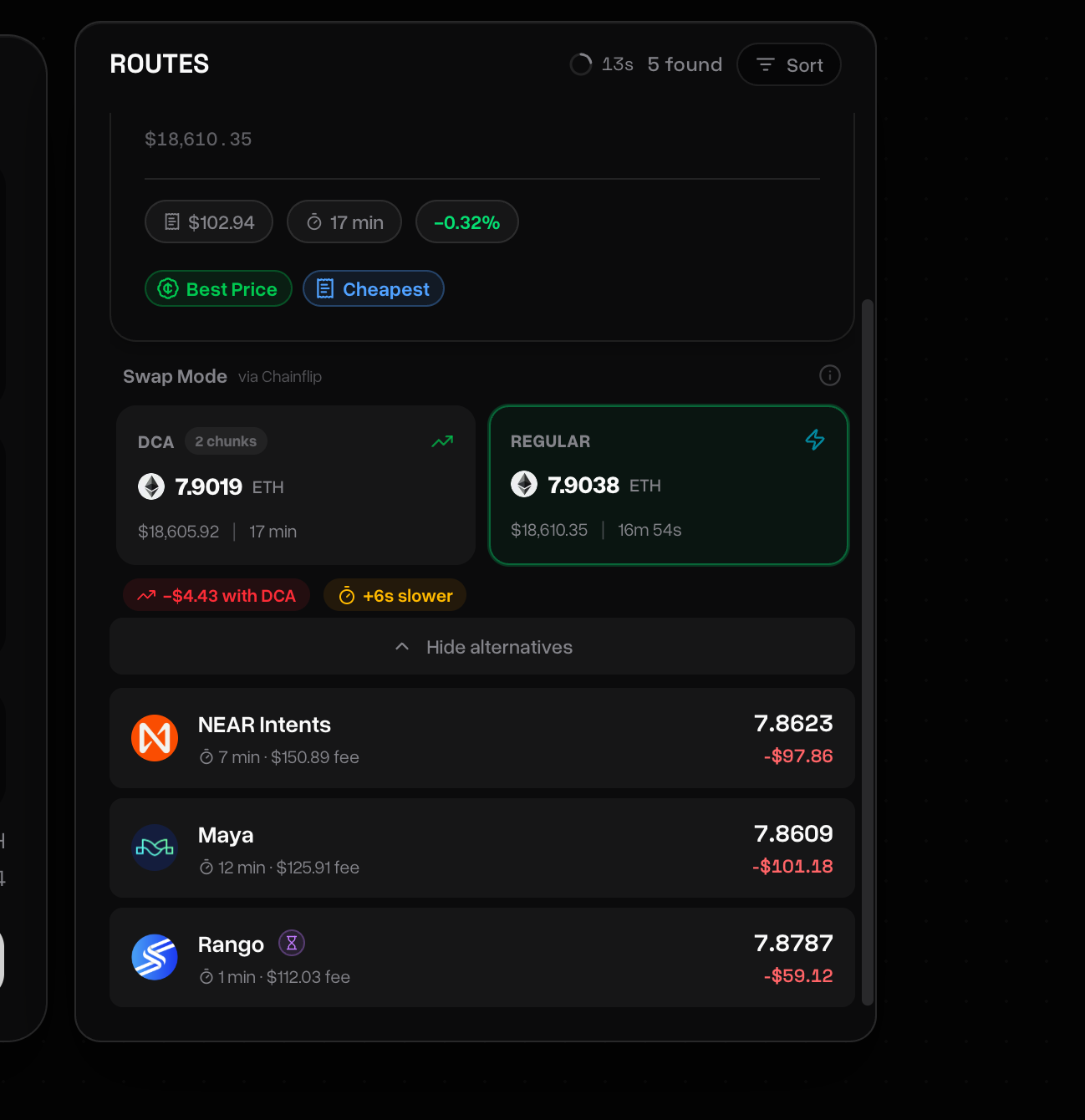
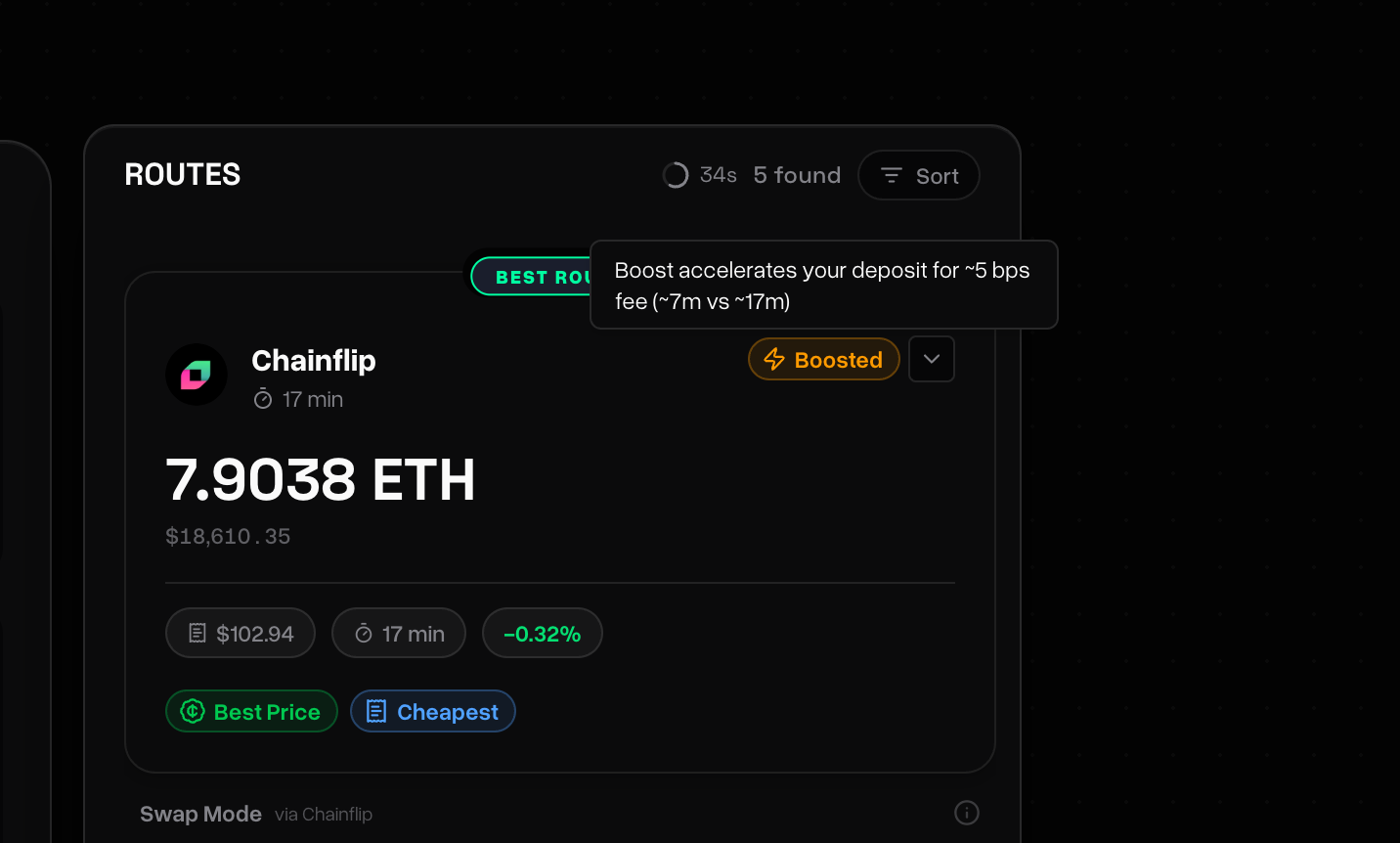
On LeoDex, the route card displays an amber "Boosted" badge when a Chainflip route has Boost available. The tooltip shows the estimated fee in basis points before you confirm, so you always know the cost upfront.
How Boost Works on LeoDex
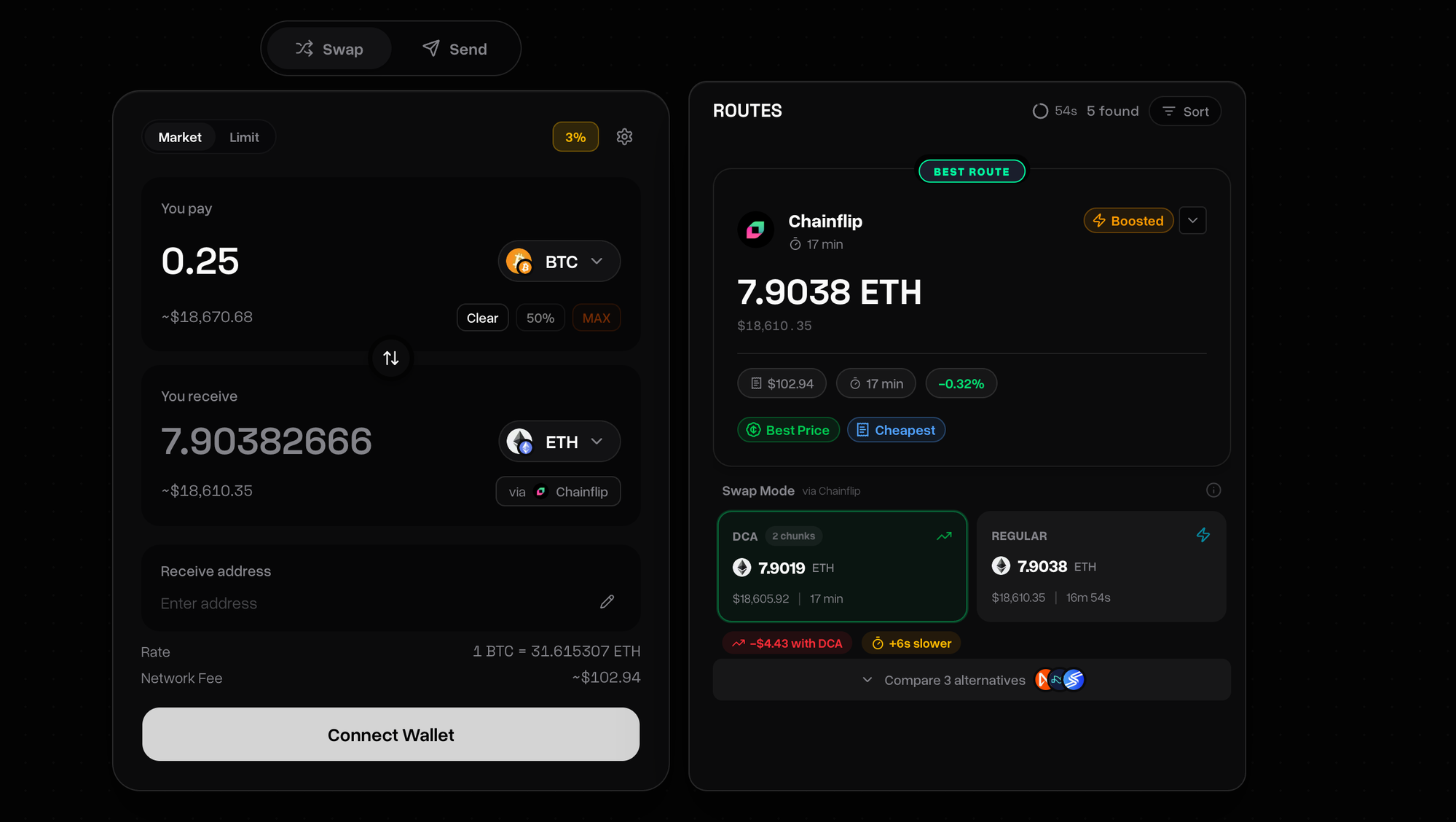
LeoDex automatically enables Boost for all Chainflip routes. There is no toggle, no setting, and no extra step. Here is what happens when you swap:
- Select your tokens — choose BTC (or another supported asset) as your source and any destination token. LeoDex streams live quotes from all protocols.
- Look for the Boosted badge — if a Chainflip route is available and Boost pools have liquidity, you will see an amber "Boosted" badge on the route card with the estimated fee and time savings. Hovering over the badge shows the exact fee and time comparison.
- Confirm the swap — review the rate, fees, and estimated time. Click swap and sign the transaction in your wallet.
- Receive tokens fast — your destination tokens arrive in approximately 30-60 seconds instead of 20-30 minutes.
Behind the scenes, LeoDex's SDK sends a maximum Boost fee of 10 bps to Chainflip when generating the deposit address. The actual fee you pay may be lower, depending on which Boost pool tiers have available liquidity.
Is Chainflip Boost Safe?
For swappers (you): Boost carries essentially no additional risk. If the Boost mechanism fails for any reason — insufficient pool liquidity, network issues, or anything else — your swap automatically falls back to standard confirmation speed. No Boost fee is charged, no funds are lost. You simply wait the normal 20-30 minutes. The worst case is the same as not having Boost at all.
For liquidity providers: LPs take on blockchain reorganization (reorg) risk. In the unlikely event that the Bitcoin block containing your deposit gets reorganized, the LP's collateral may not be fully recovered. However, Bitcoin reorgs affecting confirmed transactions are extremely rare — fewer than one per year on average, and typically only affecting unconfirmed or single-confirmation transactions. LPs price this risk into their fee tier selection.
Chainflip itself is secured by a decentralized network of validators who run the Chainflip State Chain. The protocol has been audited by multiple security firms and has processed hundreds of millions in volume. For more on the security of protocols aggregated by LeoDex, see our Security & Trust page.
Chainflip Boost vs THORChain Streaming Swaps
Boost and THORChain streaming swaps both improve the Bitcoin swap experience, but they solve different problems:
- Boost solves speed — it reduces the time you wait for BTC confirmations from ~30 minutes to under 1 minute. Your swap executes faster, but the rate is the same as a standard Chainflip swap.
- Streaming swaps solve rate — they split a large trade into many small sub-swaps executed over 10-30 minutes, reducing price impact by 1-5% on large trades. You wait longer, but you may get significantly more output tokens.
These features are complementary, not competing. A small BTC swap where speed matters is best served by Chainflip Boost. A large BTC swap ($50,000+) where getting the best rate matters more than speed is best served by THORChain streaming. LeoDex compares both approaches in real-time and surfaces whichever produces the best result for your specific trade.
Chainflip also has its own large-trade optimization: DCA mode splits swaps into chunks using the JIT AMM, offering a faster alternative to THORChain streaming with comparable rate improvements.
Earning Bitcoin Yield with Boost Pools
Boost is not just a feature for swappers — it is also an earning opportunity for Bitcoin holders. By depositing BTC into Chainflip's Boost pools, liquidity providers earn fees on every Boosted swap that uses their collateral.
Key characteristics of Boost pool LP:
- Single-sided deposits — you deposit BTC only. No need to provide a second token or manage a pair.
- No impermanent loss — your BTC is returned as BTC plus the Boost fee earned. No exposure to token price ratios.
- Fee tier selection — you choose which fee tier to deposit into (e.g., 5 bps, 10 bps). Higher tiers earn more per boost but are used only when lower tiers are exhausted.
- Risk: blockchain reorgs — if a pre-witnessed deposit is reversed due to a Bitcoin reorg, LPs absorb the loss proportionally. This is rare but non-zero.
Boost pool participation is managed directly through Chainflip's LP interface at lp.chainflip.io — it is not available through LeoDex. LeoDex is the swapper-facing side of the equation.
Frequently Asked Questions
What is Chainflip Boost?
Chainflip Boost is a speed feature that reduces Bitcoin cross-chain swap times from approximately 30 minutes to under 1 minute. It works by allowing liquidity providers to pre-confirm your BTC deposit before full blockchain finality, in exchange for a small fee (typically 5-10 basis points).
How fast are Boosted Bitcoin swaps?
Boosted Bitcoin swaps typically complete in 30-60 seconds after your BTC deposit is included in one Bitcoin block. Without Boost, the same swap would take 20-30 minutes waiting for 3 block confirmations.
How much does Chainflip Boost cost?
Boost fees are typically 5-10 basis points (0.05-0.1%) of your swap amount. On a $10,000 swap at 10 bps, the Boost fee is $10. The protocol draws from the lowest-fee pool first, so you always pay the minimum available rate.
Is Boost always available?
Boost availability depends on whether Boost pools have enough liquidity to cover your deposit. If pools are well-funded, Boost activates automatically. If not, your swap proceeds at standard confirmation speed with no Boost fee charged.
Do I need to enable Boost on LeoDex?
No. LeoDex automatically enables Boost for all Chainflip routes. There is no toggle or setting to change. When Boost is available, you will see an amber 'Boosted' badge on the route card with the estimated fee.
Is Chainflip Boost safe?
Yes. For swappers, Boost carries no additional risk. If the Boost mechanism fails, your swap falls back to standard confirmation speed with no fee charged. The worst case is identical to a normal non-boosted swap.
Does Boost work for non-Bitcoin swaps?
Boost primarily benefits Bitcoin swaps where confirmation times are longest (30+ minutes). It also works for ETH, DOT, SOL, and other Chainflip-supported assets, but the time savings are smaller since those chains already have faster confirmation times.
What happens if a Boosted swap fails?
If Boost pools lack sufficient liquidity or the boost mechanism cannot activate, your swap automatically falls back to standard Chainflip confirmation speed. No Boost fee is charged, and no funds are lost. You simply wait the normal confirmation time.