

TRON on Chainflip: the first 30 days, and how to swap USDT-TRC20 cross-chain.
TRON holds over $90 billion of USDT — more than any chain — but cashing it out used to mean an exchange. Native cross-chain swaps changed that; Chainflip's first 30 days of TRON did $25.63M, mostly USDT leaving for Bitcoin. We cover why TRON's volume is so good, how the swaps work, and how to do one yourself.
TRON carries more dollars than any other blockchain. Over $90 billion of Tether's USDT lives on it, and in 2026 it has settled roughly $4.2 trillion in USDT transfers — more than Ethereum, more than anyone. And yet, for years, cashing any of that USDT into Bitcoin or Ether meant one thing: a centralized exchange, an account, an ID. TRON was the world's dollar chain and a walled garden at the same time. That wall came down over the last year, and Chainflip just published the receipts: 30 days of native TRON swaps, $25.63 million of volume, and nearly three-quarters of it USDT walking out of TRON — most of it straight into Bitcoin.
§ 01 Why TRON's volume is so good
Start with the fact that surprises people: TRON is not really a "smart-contract platform" the way Ethereum is. It is a settlement rail for one asset — the US dollar, in the form of Tether — and it is extraordinarily good at that one job. USDT on TRON crossed $90 billion in July 2026, having overtaken Ethereum's USDT supply earlier in the year, and TRON now leads every network in USDT transfer volume for the year.01
| Label | Value (USD billions) |
|---|---|
| Jan 2023 | 33.7 |
| Jan 2026 | 84.4 |
| Mar 2026 | 85.3 |
| Jul 2026 | 90 |
The reason is boring and therefore durable: it is cheap, it is fast, and the people who move dollars for a living have standardized on it. A USDT transfer settles in about three seconds. In much of Asia, Africa, and Latin America — where dollar bank access is scarce and remittances are a lifeline — "USDT" in practice means "USDT on TRON."02 That is not a marketing narrative; it is $90 billion of revealed preference. When a chain becomes the default home for the most-used dollar on earth, its transaction volume is not a mystery. It is arithmetic.
§ 02 The exit problem, now solved
Here is the catch that made TRON a walled garden. TRON is non-EVM — it runs its own virtual machine, with base58 "T" addresses instead of Ethereum's 0x — so it never plugged neatly into the cross-chain plumbing the rest of DeFi built. For years, moving value off TRON meant a custodial bridge (and bridges are where the biggest hacks in crypto history happened) or a centralized exchange (an account, KYC, a withdrawal you don't control). Ninety billion dollars, effectively parked.
That changed over the last year, and not with a bridge. Native cross-chain protocols — the kind that hold real liquidity on both chains and settle in the real assets, no wrapping — added TRON one by one. THORChain went first, in October 2025.08 Chainflip followed. NEAR Intents and Symbiosis round out the set. The common thread: you send real USDT-TRC20, you receive real Bitcoin, and no custodian ever holds your funds in between. The "you can't swap TRON without an exchange" advice that still circulates is simply out of date.
§ 03 TRON on Chainflip: the first 30 days
Chainflip is one of those native protocols, and worth understanding because it is what LeoDex routes TRON through today. There are no wrapped tokens anywhere in it. A network of 150 validators jointly controls vaults on every supported chain using threshold signatures — no single party can move funds; it takes a two-thirds supermajority to sign. Its pricing engine is a just-in-time AMM, a rewrite of Uniswap v3 on an app-specific chain, where market makers bid to fill your swap the moment your deposit lands. You request a swap, the protocol hands you a one-time deposit address, you send your TRON to it, and native Bitcoin arrives at the other end. Fire and forget.06
On July 16, 2026, Chainflip published TRON's first-30-day numbers, and they are the reason this article exists. By Chainflip's own data: $25.63 million in volume across 956 swaps, an average swap of roughly $26,800, and a single largest swap of $366,707 — USDT-TRC20 into Bitcoin. Seventy-three percent of the flow was outbound, USDT leaving TRON. The top route, by a wide margin, was USDT-TRC20 → BTC at $7.41 million.05
| Label | Value (USD millions) |
|---|---|
| USDT→BTC | 7.41 |
| BTC→USDT | 3.87 |
| USDT→USDT(ETH) | 3.63 |
| USDT→USDC | 3.21 |
| USDT→ETH | 2.88 |
It cleared Chainflip's $20 million stretch target and did more than three times the volume of its own Solana launch over the same 30-day window — with about 40% fewer swaps, meaning each TRON swap was roughly five times larger. This is not retail dust. This is size, moving USDT off the dollar chain and into hard crypto, without asking anyone.
| Label | Value (USD millions) |
|---|---|
| TRON | 25.63 |
| Solana | 8.23 |
- Volume / swaps
- $25.63M across 956 swaps — average ~$26,800, largest $366,707 (USDT-TRC20 → BTC)
- Direction
- 73% outbound ($18.78M leaving TRON), 27% inbound — up from 14% inbound in week one
- Top route
- USDT-TRC20 → Bitcoin, $7.41M — the single biggest flow
- vs Solana launch
- 3x the volume of Chainflip's Solana launch (same 30-day window), ~40% fewer swaps
- vs target
- Cleared the $20M stretch target ($8M base); 9 integrations live vs a 2–5 goal
- Source
- Chainflip's own report and public Scan explorer — a launch report, not an audit
§ 04 The honest limits
Now the part the launch post won't dwell on.
The 30-day figures are Chainflip's own, drawn from its public Scan explorer — impressive, but self-reported and worth reading as a launch announcement, not an audit.07 And they flatter the protocol more than its partners: about 93% of that volume came through Chainflip's own swap app. The integrator ecosystem is real but early — Chainflip names nine frontends carrying TRON, LeoDex among them, but the named broker-volume leaderboard is led by others and measured in the hundreds of thousands, not millions. Being one of the nine is the honest claim; being the whale is not.
TRON was the world's dollar chain and a walled garden at the same time. The wall is what came down — not the dollars.
Then there is TRON itself. It is centralized by design — 27 elected "Super Representatives" produce all its blocks, and Justin Sun's influence over its direction is well documented; the SEC's long-running case against him and the Tron Foundation was settled in March 2026 with a $10 million penalty and no admission of wrongdoing.09 And TRON's fee model has a sharp edge for newcomers: sending USDT-TRC20 burns "energy," which you pay for in TRX, so you need a little TRX in your wallet as gas — a few dollars, more if you're paying out to a brand-new address.04 None of this is disqualifying. All of it is worth knowing before you move size.
§ 05 How to swap TRON cross-chain on LeoDex
On LeoDex, a TRON swap routes through Chainflip, and you can do it two ways: connect a TRON wallet, or connect nothing at all.10
- Open the swap and pick your pair — for example USDT-TRC20 → BTC. LeoDex streams live quotes; when TRON is the source, Chainflip is the route, shown on the card.
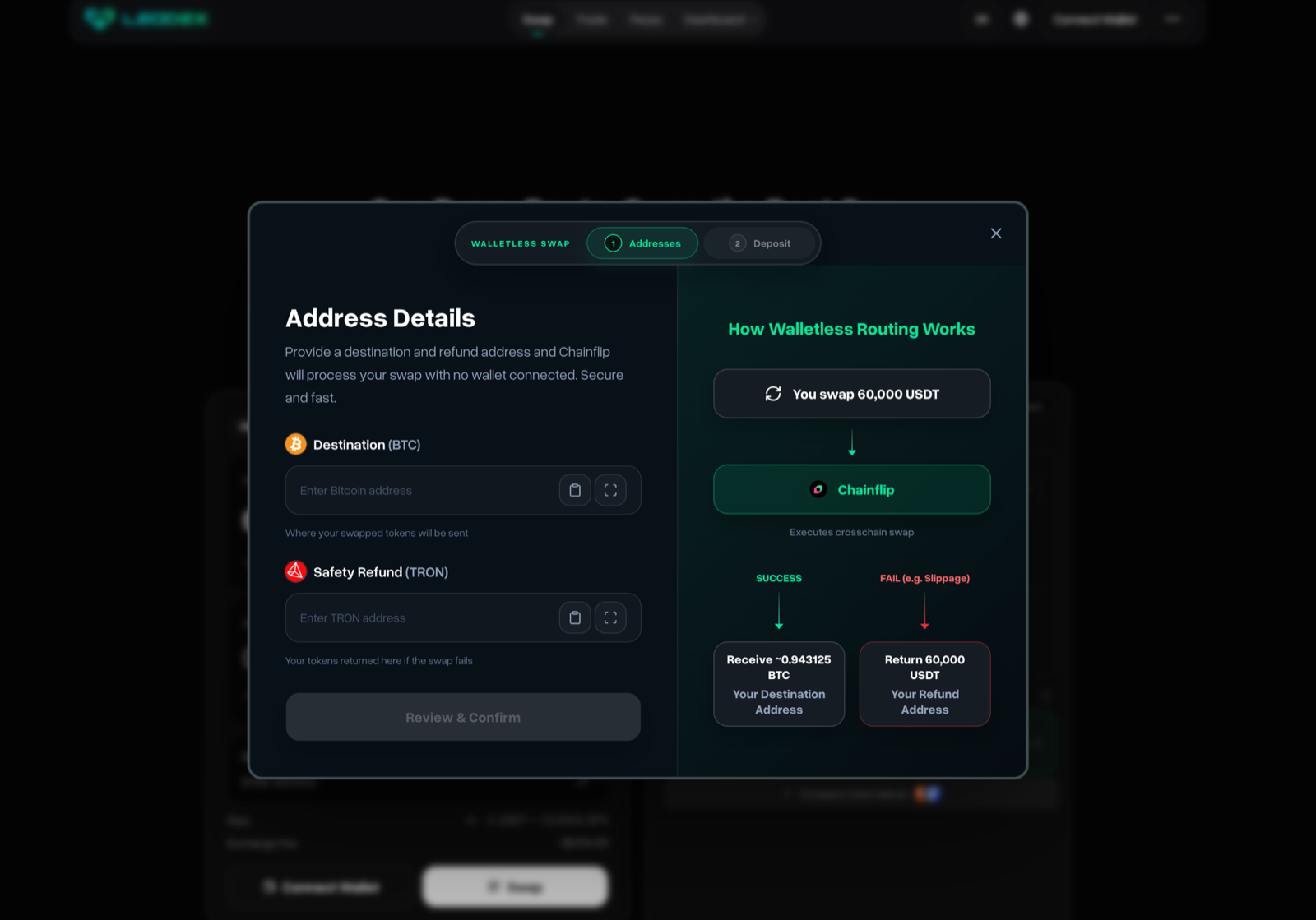
- Choose how to sign. Connect TronLink to sign from your wallet, or go walletless: enter a destination address (where your BTC lands) and a refund address (where funds return if the swap can't complete). No account, no KYC either way.
- Fund the gas. Keep a little TRX in the sending wallet — USDT-TRC20 transfers burn energy, paid in TRX. A few dollars covers it.
- Send to the deposit address. Chainflip mints a one-time deposit channel; you send your USDT-TRC20 to it. That on-chain send is the whole commitment — no approvals, no wrapping.
- Receive native. Validators witness the deposit, the JIT AMM fills it, and real Bitcoin is broadcast to your destination address. TRON confirmations are quick; the destination leg depends on the chain.
- Verify. The swap is traceable on Chainflip's Scan explorer end to end, and the assets settle in your own wallet — LeoDex never holds them.
That is the whole point of doing it this way. The dollars were always yours; now the exit is too — to Bitcoin, to Ether, to any chain, without an account and without permission.
Survive > maximise. Your dollars, your keys, any chain.
Frequently asked questions
Q.How do I swap USDT off TRON without a centralized exchange?
Use a native cross-chain protocol. On LeoDex, a USDT-TRC20 swap routes through Chainflip: you send USDT-TRC20 to a one-time deposit address and receive native Bitcoin, Ether, or another asset in your own wallet — no account, no KYC, and no custodian holds your funds.
Q.Why is TRON's stablecoin volume so high?
TRON is the default settlement rail for Tether's USDT. It holds over $90 billion of USDT — more than Ethereum — with roughly three-second finality and low transfer costs, which made it the standard for remittances and dollar access across emerging markets. High supply plus heavy use equals high volume.
Q.Can I swap TRX or USDT-TRC20 to Bitcoin natively?
Yes. Since native TRON support arrived (THORChain in October 2025, then Chainflip and others), you can swap TRX and USDT-TRC20 directly to Bitcoin, Ether, and other chains without wrapping or bridging. On LeoDex these route through Chainflip, settling in the real assets.
Q.How did TRON's first 30 days on Chainflip go?
By Chainflip's own report (July 16, 2026): $25.63 million across 956 swaps, averaging ~$26,800, with a largest single swap of $366,707. Seventy-three percent was outbound — USDT-TRC20 → Bitcoin the top route at $7.41M — clearing Chainflip's $20M stretch target and roughly tripling its Solana launch.
Q.Is swapping TRON cross-chain safe?
Native swaps avoid the custodial-bridge risk behind crypto's largest hacks — funds settle in real assets and stay in your wallet. The residual risks are ordinary: protocol smart-contract risk, slippage on thin pairs, and the trust assumptions of the settlement network. Self-custody and no-KYC swapping are legal in most jurisdictions.
Q.Do I need TRX to swap USDT off TRON?
Yes, a little. Sending USDT-TRC20 consumes TRON 'energy,' which is paid in TRX, so you need a small TRX balance as gas — usually a few dollars' worth, more when paying out to a brand-new address. This is a TRON network requirement, not a LeoDex or Chainflip fee.
References & Sources
TRON supply and volume figures are independently sourced (The Block, DefiLlama, TRONSCAN) and dated, because they move daily. The 30-day swap figures are Chainflip's own, from its public Scan explorer, and are presented as a launch report rather than independently audited data. Nothing here is financial advice. All URLs verified July 16, 2026.
TRON & USDT Data
- [01]“USDT on TRON exceeds $90 billion as TRON leads USDT transfer volume with $4.2 trillion YTD”. theblock.co www.theblock.co/post/407792/usdt-on-tron-exceeds-90-billion-as-tron-leads-usdt-transfer-volume-with-4-2-trillion-ytd
- [02]“Stablecoin supply by chain — live TRON vs Ethereum USDT distribution”. defillama.com defillama.com/stablecoins/chains
- [03]“TRON network activity — daily transactions, active accounts, TVL”. tronscan.org tronscan.org
- [04]“How much does it cost to send USDT-TRC20 — TRON energy, bandwidth, and account activation”. blog.tronsave.io blog.tronsave.io/how-much-does-it-cost-to-send-usdt-trc20/
Chainflip: Primary Sources
- [05]“TRON on Chainflip — the first 30 days (the report this piece analyzes; LeoDex named among nine integrations)”. chainflip.io chainflip.io/blog/tron-chainflip-first-30-days
- [06]“How Chainflip works — validators, multi-chain vaults, the JIT AMM, and deposit channels”. docs.chainflip.io docs.chainflip.io/
- [07]“Chainflip Scan — the public explorer behind the reported swap figures”. scan.chainflip.io scan.chainflip.io/swaps
Native TRON Cross-Chain & Regulatory
- [08]“TRON integration complete — native TRX + USDT swaps live on THORChain”. medium.com medium.com/@ninerealms/tron-integration-complete-native-trx-usdt-swaps-live-on-thorchain-3794e7111b00
- [09]“SEC litigation release — settlement in SEC v. Sun / Tron Foundation ($10M penalty, no admission)”. sec.gov www.sec.gov/enforcement-litigation/litigation-releases/lr-26496
LeoDex
- [10]“LeoDex — non-custodial cross-chain swaps, including native TRON (USDT-TRC20, TRX) via Chainflip”. leodex.io leodex.io