

How to Swap Stablecoins with No KYC and Low Fees (2026)
Key Takeaways
- •A non-custodial swap has no account, so there is nothing to KYC and nothing to freeze — structurally different from a 'no-KYC' exchange that still holds your funds and tightens limits later.
- •Stablecoins sit near $1, so the realized spread is tiny: expect roughly 1-25 basis points plus network gas, and intent routes like NEAR Intents can be as low as 1 bp. The chain you pick affects cost more than the protocol does.
- •The whole flow is five steps — connect wallet, pick the two stablecoins and their chains, compare the routed quotes, check the all-in number, sign from your wallet. No email, no deposit, no withdrawal queue.
To swap stablecoins with no KYC and low fees, connect a self-custody wallet to a non-custodial aggregator like LeoDex, choose your two stablecoins and the chains they live on, compare the routed quotes, and sign the transaction from your own wallet. There is no account, no email, and no deposit. Fees typically run from about 1 to 25 basis points plus network gas, and you see the exact amount out before you sign.
Most "no-KYC" guides are written by people selling you the platform they rank #1. This one is different in a specific way: a non-custodial swap has no account at all, so the KYC question mostly dissolves — there is no sign-up form to fail and no balance for anyone to freeze. This guide covers why that matters, what a stablecoin swap actually costs, the five steps to do one, which route is cheapest, and the honest risks nobody else lists.
This is independent educational content, not financial advice. You are responsible for your own tax reporting and for following the rules in your own jurisdiction.
Why swap stablecoins without KYC?
Because the cleanest way to avoid KYC is to never create an account in the first place. A non-custodial swap is wallet-to-wallet: your stablecoins move from your wallet, through a protocol's smart contract or liquidity vault, and back to your wallet. No company ever holds the funds, so there is no entity that needs to identify you and no balance sitting on a platform that can be frozen, limited, or closed.
That is the part the listicles blur. A "no-KYC exchange" is usually a custodial business that has simply not asked for your ID yet — withdrawal limits tighten, a compliance review lands, and the KYC request arrives exactly when you want your money out. A non-custodial aggregator has no such lever to pull. The difference is structural, not a setting.
Be honest with yourself about what "no KYC" does and does not mean, though:
- It is pseudonymous, not anonymous. No platform links the swap to your legal identity, but every transaction is permanent and public. Anyone can read your wallet's history on a block explorer.
- Stablecoins themselves can still be frozen. USDT and USDC are issued by companies (Tether and Circle) that can blacklist an address at the token level — independent of any exchange. No-KYC swapping does not change that; it only removes the custodial middleman.
- You still owe your taxes. Swapping one token for another is a taxable disposal in the US and most jurisdictions, whether or not anyone asked for your ID. Skipping KYC is not skipping the rules — see is no-KYC swapping legal.
What does it actually cost?
Stablecoin swaps are the cheapest trades in crypto for a simple reason: both sides sit near $1, so there is almost no price to move. The realized spread is tiny, and total cost comes down to three line items — the protocol fee, network gas, and the aggregator's fee.
- Protocol fee: roughly 1-25 basis points depending on the route. Intent-based routing like NEAR Intents can be as low as 1 bp (0.01%) because professional solvers compete to fill your order.
- Network gas: often the largest cost, and it has nothing to do with the swap fee. An ERC-20 transfer on Ethereum mainnet can cost more than the entire swap; the same trade on Solana, BNB Chain, or an L2 like Base or Arbitrum costs cents. Pick the cheap chain and you win the fee fight before it starts.
- LeoDex fee: 0.45%, shown transparently inside the quote — not a hidden spread bolted onto the rate. You see the all-in number before you sign.
The takeaway: on stablecoins, the network you choose usually matters more than the protocol. A $5,000 USDT-to-USDC swap on an L2 can settle for a few dollars all-in; the same swap routed over Ethereum mainnet at a busy hour can cost ten times that in gas alone.
How to swap stablecoins with no KYC in 5 steps
The whole thing takes about a minute once your wallet is connected. Budget a little longer the first time.
- Open LeoDex and connect your wallet. Go to leodex.io — the swap interface loads immediately, no login. Click Connect Wallet and pick your provider (MetaMask, Phantom, Coinbase Wallet, Rabby, Ledger, Trust Wallet, Keplr, and more).
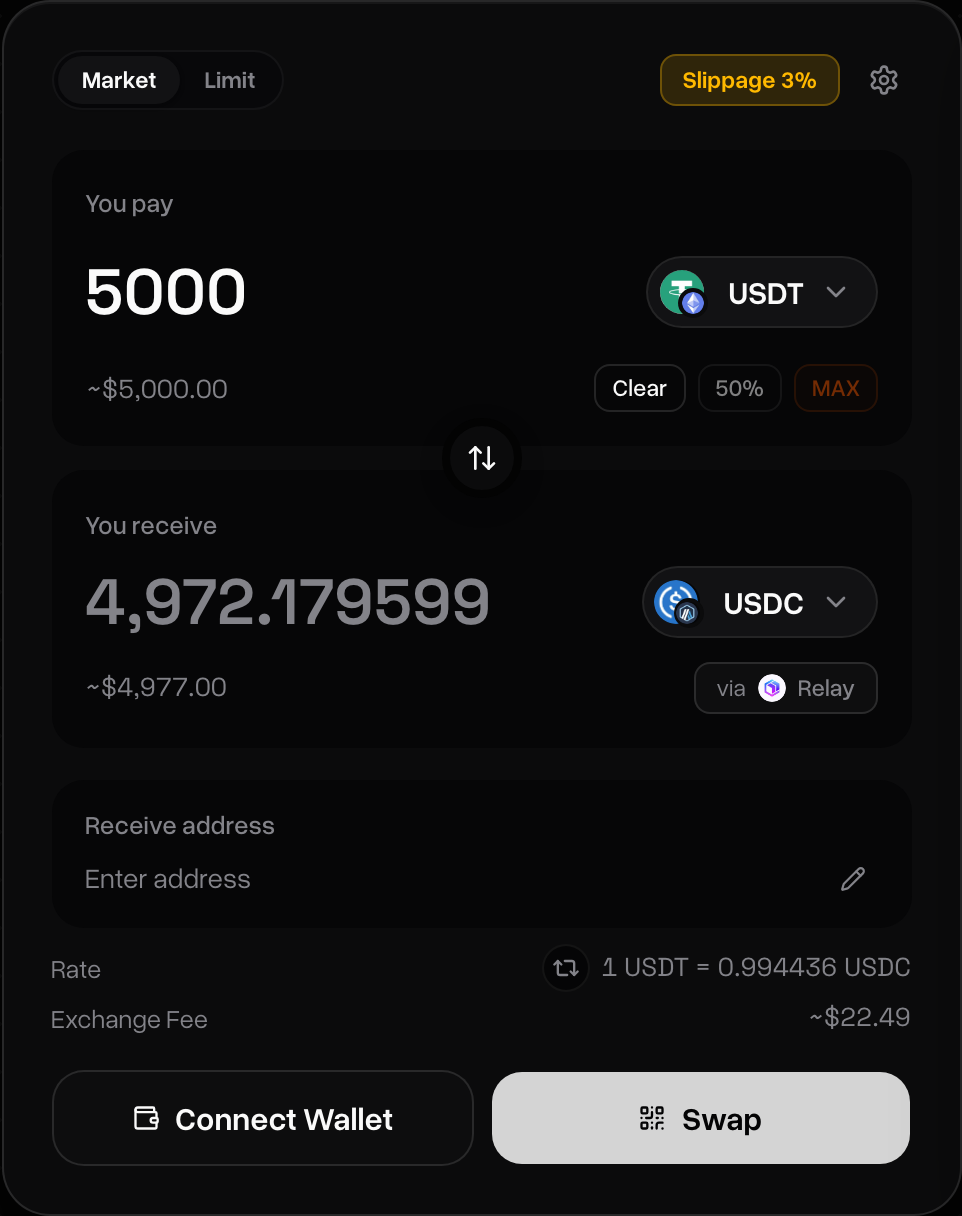
- Pick your two stablecoins and their chains. Choose the "From" asset (e.g. USDT on Ethereum) and the "To" asset (e.g. USDC on Arbitrum). LeoDex covers USDC, USDT, DAI, PYUSD, USD1, FRAX, crvUSD, EURC and more across roughly 11 chains. Enter the amount.
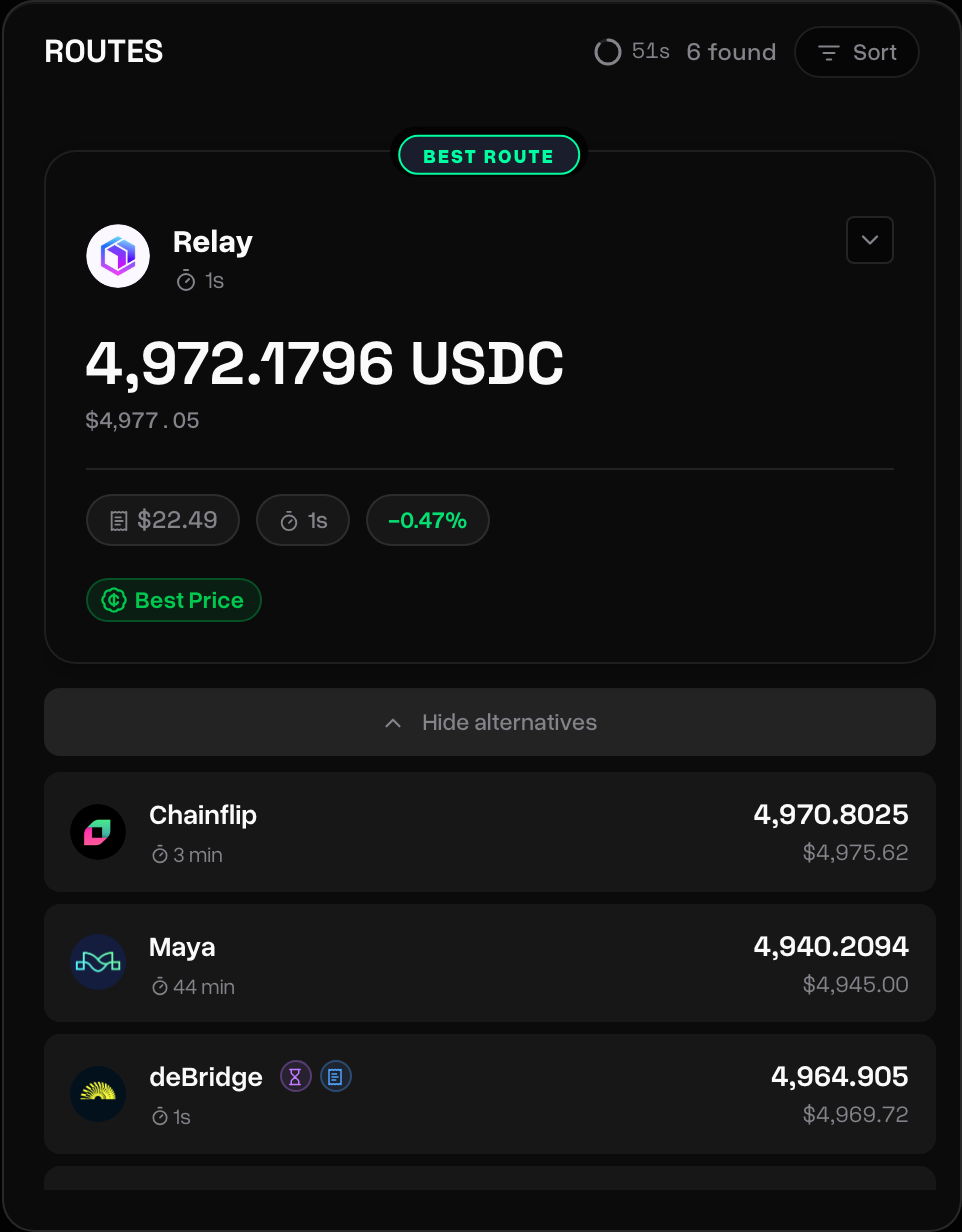
- Compare the routed quotes. LeoDex streams live quotes from every protocol at once and surfaces the best route at the top. Click to compare alternatives and read the protocol badge — THORChain, Chainflip, NEAR Intents, Relay, or Maya.
- Check the all-in number. The quote shows the exact amount you will receive, the fee breakdown (protocol + gas + LeoDex 0.45%), and the estimated time. There are no surprise withdrawal or deposit fees because there is no platform holding your money.
- Sign from your wallet. Approve the transaction in your wallet (or on your hardware device). Your stablecoins are sent to the route's smart contract or deposit address, the protocol settles, and the destination stablecoin arrives in your wallet — usually in under a minute for same-stack EVM swaps.
Which route is cheapest for your swap?
You do not have to choose a protocol — LeoDex aggregates all of them and picks the best output automatically. But it helps to know what each is good at, and which column the no-KYC listicles always leave out: custody.
| Route | Best for stablecoins | Typical fee | KYC | Custody |
|---|---|---|---|---|
| NEAR Intents | Cheapest cross-chain swaps and exotic chains (TON, TRON, Sui, Stellar) | ~1 bp (0.01%) | None | Self-custody |
| Relay | Fast same-asset transfers across EVM L2s | Low, solver-filled | None | Self-custody |
| Chainflip | Tight same-chain spreads, MEV-protected | JIT, slip-based | None | Self-custody |
| THORChain | Cross-chain majors with deep liquidity | ~5-30 bps, slip-based | None | Self-custody |
| Maya Protocol | Alt routing and privacy assets (ZEC, DASH) | Slip-based | None | Self-custody |
| LeoDex (aggregator) | Picks the best of all routes for you | Best available + 0.45% | None | Self-custody |
| "No-KYC" CEX listicle pick | Marketing | Opaque spread + withdrawal fees | Creeps back via limits/holds | Custodial |
The pattern: for a cross-chain stablecoin move, NEAR Intents is usually the cheapest because solver competition is fiercest on high-volume pairs. For majors on big L1s, THORChain's depth can win. LeoDex compares all of them on every quote so you never have to guess — see how cross-chain swapping works for the mechanics.
Is no-KYC stablecoin swapping legal and safe?
For individuals, using a non-custodial DEX or aggregator is generally legal in most jurisdictions — regulators target custodial platforms that hold other people's money, not people swapping from their own wallets. Rules vary by country, and you remain responsible for your own tax reporting regardless of whether KYC was required.
"Safe" is a different question with honest answers:
- Counterparty risk is near zero because no one holds your funds. That is the entire point — there is no platform to go bankrupt with your stablecoins inside it. (For the why, read how to move crypto off an exchange.)
- Smart-contract and protocol risk are real but bounded. THORChain, Chainflip, NEAR Intents, Relay, and Maya have each settled large cumulative volume; LeoDex shows you the exact protocol, fee, and time before you confirm.
- Issuer freeze risk persists regardless of how you swap, because Tether and Circle can blacklist addresses at the token level. If censorship-resistance is your goal, decentralized stablecoins like DAI or crvUSD behave differently from USDT and USDC.
What can go wrong?
Three mistakes account for almost every bad stablecoin swap, and all are preventable:
- Wrong chain. USDC on Arbitrum is not USDC on Ethereum. Match the destination chain to the wallet and network you actually control, and confirm the route's target chain in the quote before signing.
- Ignoring minimums on large or thin pairs. Some routes set minimum amounts, and a very large trade in a shallow pool can still show slippage even on stablecoins. Compare alternatives and, for big sizes, check whether a deeper route nets more out.
- Swapping during a depeg. Stablecoins occasionally wobble off $1 during market stress. The quote always reflects the live rate, so read the amount out — if a "stable" pair is pricing oddly, wait for the peg to settle.
Start swapping
The honest pitch for no-KYC stablecoin swapping is not that it hides you — it does not. It is that the account you never created is the one nobody can freeze, and the fee you can see is the one nobody can pad. You connect a wallet, compare real routes, and sign a transaction you control end to end.
That is the whole skill. Start with a small swap to learn the flow, then scale up: open leodex.io, try a no-KYC swap, or browse the stablecoin hub to see supported assets and chains. Self-custody was supposed to be the hard part — swapping from it is just signing.
Frequently Asked Questions
Do you need KYC to swap stablecoins?
No. Swapping stablecoins on a non-custodial DEX or aggregator like LeoDex requires no KYC, account, or email — you connect your own wallet and the swap settles wallet-to-wallet via smart contracts. KYC is imposed only by centralized exchanges that custody your funds, not by permissionless on-chain protocols.
What's the cheapest way to swap USDT to USDC?
Use a low-fee chain plus a non-custodial aggregator. Stablecoin swaps cost roughly 1-25 basis points plus gas, and intent routes like NEAR Intents can be about 1 bp. Pick a cheap network — Solana, BNB Chain, or an L2 like Base or Arbitrum — since ERC-20 gas on Ethereum mainnet often dwarfs the swap fee itself.
Is it legal to swap stablecoins without KYC?
For users, yes in most jurisdictions — using a non-custodial DEX is generally legal, though rules vary by country. Regulators target custodial platforms that hold other people's funds, not individuals swapping from self-custody. You remain responsible for your own tax reporting regardless of whether KYC was required.
Are no-KYC stablecoin swaps anonymous?
No — they are pseudonymous, not anonymous. No-KYC means no platform links the swap to your legal identity, but every transaction is permanently visible on the public blockchain. Anyone can view a wallet's activity via a block explorer, so on-chain traceability still applies.
Can I swap stablecoins across chains without a bridge?
Yes. Intent-based and cross-chain protocols (NEAR Intents, Relay, THORChain, Chainflip, Maya) deliver the destination stablecoin natively in one transaction — no manual bridging and no wrapped tokens. Solvers or liquidity pools handle the cross-chain routing while your assets stay in your custody throughout.
What does "non-custodial" mean for a stablecoin swap?
Non-custodial means no company ever holds your funds. Assets move directly from your wallet to your wallet, settled by smart contracts or threshold-signature vaults. Because there is no intermediary custodying funds, there is no account to register and nothing for a platform to freeze.